antiques

Prestige Axe, Ibia
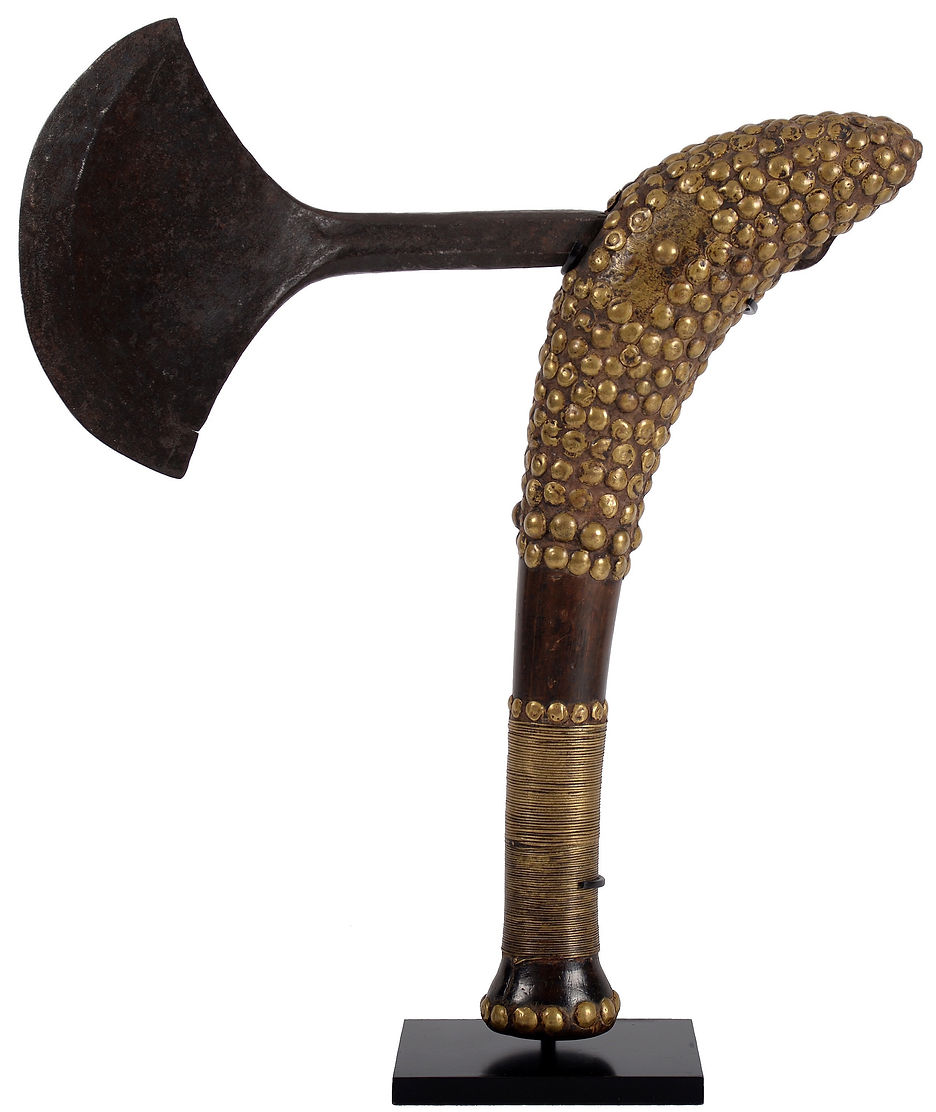

Offered here an old and very well preserved axe with an iron half moon shaped blade joined to the handle by a thick and long octagonal section stalk.
The tang ends up through the handle, cocked and bent upwards. A typical feature of this type of axe.
The steel with black patina and no corrosion. In my opinion something also difficult to see in today's obsession with clean, shiny, patina free blades. It has a small old delamination at the bottom near the edge. Completely solid.
There is no movement between the blade and the handle. Solid piece with no looseness.
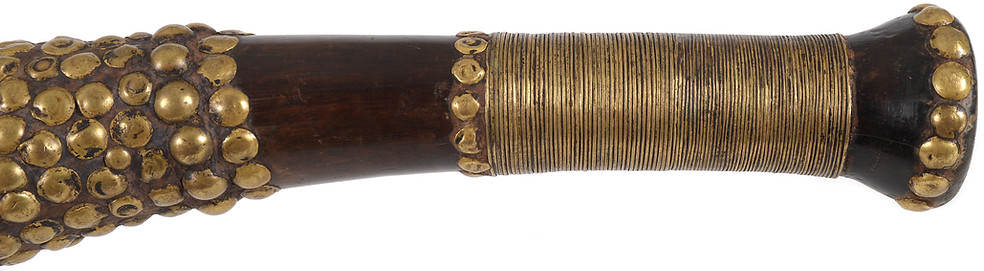
Dense and heavy wooden handle. With signs of use but as can be seen in the photographs in very good condition and with a fantastic dark and shiny tone that emanates age and wear.
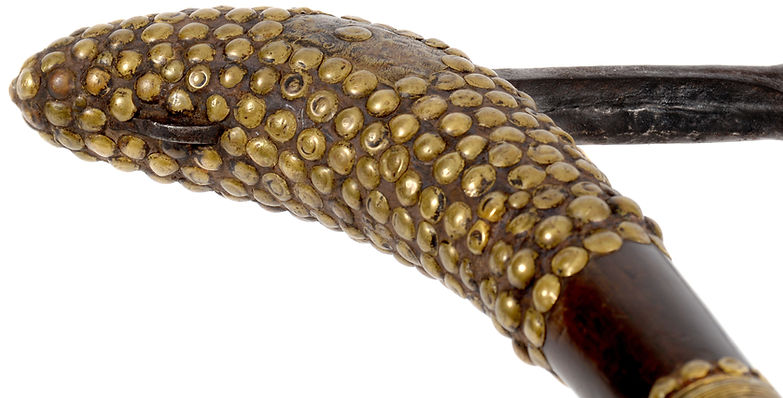
Intricately decorated with brass tacks. Two different sizes, note the second ring on the upper part of the handle.
On each side the handle has two thin brass plates which act as an eye at the point where the blade meets the handle. This eye or design is also common on this type of axe, but it is not present on all of them. I suppose this detail must have belonged to a particular village, area or had a meaning that we have lost today.
Prestige Axe of high social rank,chiefs. Ibia.
Teke, Laali, Mboshi, Mfinu, Kuyu. Rep. of Congo/ D.R. Congo/ Gabon.
Judging by its appearance, one might think that this is a conventional weapon.
However, its careful workmanship, details and dramatic proportions denote a concern that goes beyond its possible functionality to become a symbol of sovereignty.
In the hands of the chief, a person of high rank or important lineage, emanates the necessary power to do justice and guarantee, as far as possible, peace in the heart of these small communities.
The axe gives the man who holds it, the ritual, a sacred character as he acts as a mediator or interpreter of a superior being.
Two comparable examples at MFA Boston Museum,
and .
References,
- WESTERDIJK HEINRICH, Ijzerwerk van Centraal-Afrika, Lochem 1975, Gruppo XI, pag.93, fig. 14 (199)
- ZIRNGIBL MANFRED A., Seltene Afrikanische Kurzwaffen, Grafenau 1983, pagg. 96 e 97 (238)
- SCHAEDLER KARL-FERDINAND, Erde und Erz, Panterra Verlag Edition Minerva, Munchen 1997, pag. 337, n° 662 (537)
- DUPRE’ MARIE-CLAUDE, Batéké: peintres et sculpteurs d’Afrique Centrale, Musées Nationaux, Paris 1998, pagg. 106 e 107 (Ibia) (813)
- FALGAYRETTES LEVEAU CHRISTIANE, Chasseurs et guerriers, Musée Dapper, Paris 1998, pagine 202 e 208 (529)
- ELSEN JAN, De fer et de fierté: Armes blanches d’Afrique Noire du Musée Barbier-Mueller, Genéve & Milan 2003, pag. 213 (524)
- ELSEN JAN, Fatal Beauty: Traditional weapons from Central Africa, Bruxelles 2009, pag. 289, n° 374 (643)
Between the tacks, either on the upper or lower part of the handle, there is a substance that looks earthy as a kind of dried mud and homogeneous. After studying it carefully I think, and this is my opinion, I rule it out as dirt accumulated over time and it could be part of the original decoration that still remains.
It should be noted that not a single stud is missing and they are all very original.
Nice workmanship.
Powerful in hand.
Great opportunity to add to your collection a rare, iconic and high-powered piece in excepcional condition from the deep heart of Africa.

Dating, Late 19th century- early 20th century.
Provenance, Private French old collection.
Overall length: 37,4 x 33,3 cm
Blade length: 21 x 17,2 cm
Stalk thickness, 2 x 2 cm.
Weight, 1160 grams.
Mounted on a custom display stand.
Price on Request



In “Of Iron and Pride” (2003), Jan Elsen writes of a similar axe from the Barbier-Mueller Museum collection: “Like the famous brass collars, the weapon is an integral part of the chiefs' parade dress. Contrary to what one might think, these axes give, once in the hand, a sense of ultimate balance, they were certainly formidable weapons” (p. 212, fig. 76).
Exhibit: A FALCON’S EYE: TRIBUTE TO SHEIKH SAOUD AL THANI at the Museum of Islamic Art, Doha. August 2020- April 2021.
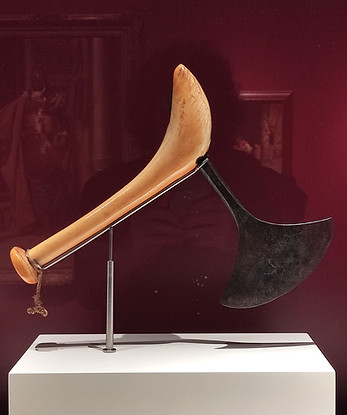
Teke axe, 19th century. Al Thani Collection.
Qatar Museums Collection STM. ET. VA. 002
This axe with the same straight handle like the one offered here.