antiques

"US Model 1941 Naval Cutlass"
The “klewang” or military cutlass was developed at the end of the 19th century to equip the Dutch colonial troops with an effective weapon for hand-to-hand combat and warfare in the jungle against indigenous “rebels”. Ironically, this cutlass was based on the model used by these same rebels, that is why it is also known by its Indonesian name, "klewang".
Such was its success that it was in use from 1898 to the 60s (20th century).
In 1941 the Dutch government in exile, ordered to the American company Lilley-Ames Co. of Columbus, Ohio, about 3,000 units of this saber destined for their East Indies troops. At the same time the government of the United States ordered to the same company a similar number for his South Pacific Navy, being many of these units used by the Marines. Although the production was carried out by Lilley-Ames, the assembly of the units destined for the Dutch government was made by Vince Fencing Equipment Co. and marked "VINCE." The units produced and assembled by Lilley-Ames were unmarked and the grips were or in black bakelite or in black painted wood, not like the ones from Vince Fencing Equipment which had natural wooden grips.
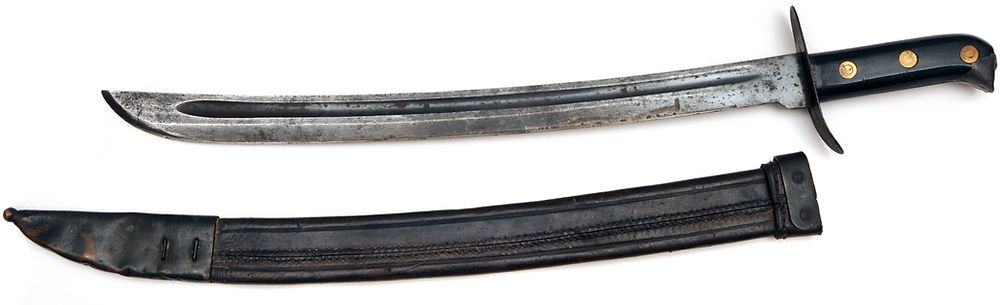
During the war, the models captured by the Japanese were modified for their own use. The ones from the sympathetic Indonesian recruits to the Japanese were known as "Heiho." For this they removed the original "basket" guard for a simple slightly curved cross guard, they also shortened the blades losing their particular concave tip and acquiring a profile similar to a machete, although they also remind us the " wakizashi ”or short sword of the samurai.
During that war some of these models were captured again by the allied forces, returning to the original side.
The item we offer here is one of these units, the cutlass model 1941 for the US Navy, in English "US Model 1941 Naval Cutlass" but modified by the Japanese for their own purpose.
The "klewang" is in very good condition. It is sturdy and everything stays in place without any movement..
The blade, in good condition, has some minor point of rust. Even with the modification, with some sharpenings and its hazardous life it still retains much of its blueing.
Let's not forget that it was a piece made for what it was made and its edge gives a good account of it.
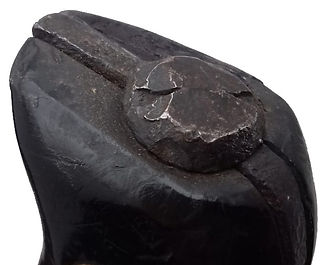
The handle and the guard are in good condition, just a few details to highlight. The knob instead of keeping the brass screw that secured the guard, seems hammered, we suppose that the Japanese when removing the guard believed that it was not necessary to keep it and finished it in that way. Another detail is that a small part of the pommel was replaced with lead, surely also in times of war, otherwise the handle is very good and the iron guard maintains a stable patina.
It is also noteworthy that it retains its original and in very good condition scabbard.
The whole set has a spectacular patina.
Inside scabbard 62.7 cm, out 56,7 cm. Blade 44,6 cm, width 3 cm and a thickness of 0,5 cm.
In a fantastic condition and with fantastic I also mean the scars that it wears. Any lover of modern history weapons would enjoy this piece that participated in one of the most decisive and bloody events in our history.
Price: 285 €,-